### New version ProxMenux v1.2.1 — *SR-IOV Awareness & GPU Passthrough Hardening*
Targeted release on top of **v1.2.0** addressing three community-reported areas that needed fixing before the next stable cycle: full SR-IOV awareness across the GPU/PCI subsystem, robust handling of GPU + audio companions during passthrough attach and detach (Intel iGPU with chipset audio, discrete cards with HDMI audio, mixed-GPU VMs), and compatibility fixes for the AI notification providers (OpenAI-compatible custom endpoints such as LiteLLM/MLX/LM Studio, OpenAI reasoning models, and Gemini 2.5+/3.x thinking models). Also bundles quality-of-life fixes in the NVIDIA installer, the disk health monitor, and the LXC lifecycle helpers used by the passthrough wizards.
---
## 🎛️ SR-IOV Awareness Across the GPU Subsystem
Intel `i915-sriov-dkms` and AMD MxGPU split a GPU's Physical Function (PF) into Virtual Functions (VFs) that can be assigned independently to LXCs and VMs. Previously ProxMenux had zero SR-IOV awareness: it treated VFs and PFs identically, which could rewrite `vfio.conf` with the PF's vendor:device ID, collapse the VF tree on the next boot, and leave users unable to start their guests. Every path that could disrupt an active VF tree has been audited and hardened.
### Detection helpers
- New `_pci_is_vf`, `_pci_has_active_vfs`, `_pci_sriov_role`, `_pci_sriov_filter_array` in `scripts/global/pci_passthrough_helpers.sh`
- HTTP/JSON equivalents in the Flask GPU route — the Monitor UI reads VF/PF state directly from sysfs (`physfn`, `sriov_totalvfs`, `sriov_numvfs`, `virtfn*`)
### Pre-start hook (`gpu_hook_guard_helpers.sh`)
The VM pre-start guard now recognises Virtual Functions. Both the slot-only syntax branch (which used to iterate every function of the slot and demand `vfio-pci` everywhere) and the full-BDF branch skip VFs, so Proxmox can perform its per-VF vfio-pci rebind as usual. The false "GPU passthrough device is not ready" block on SR-IOV VMs is gone.
### Mode-switch scripts refuse SR-IOV operations
`switch_gpu_mode.sh`, `switch_gpu_mode_direct.sh`, `add_gpu_vm.sh`, `add_gpu_lxc.sh`, `vm_creator.sh`, `synology.sh`, `zimaos.sh` and `add_controller_nvme_vm.sh` all reject VFs and PFs with active VFs before touching host configuration. A clear "SR-IOV Configuration Detected" dialog explains the situation. For wizards invoked mid-flow (VM creators) the message is delivered through `whiptail` so it interrupts cleanly, followed by a per-device `msg_warn` line for the log trail.
### New "SR-IOV active" state in the Monitor UI
The GPU card in the Hardware page gains a third visual state with a dedicated teal colour, an in-line `SR-IOV ×N` pill (or `SR-IOV VF` for a Virtual Function), and dashed/faded LXC and VM branches. The Edit button is hidden because the state is hardware-managed.
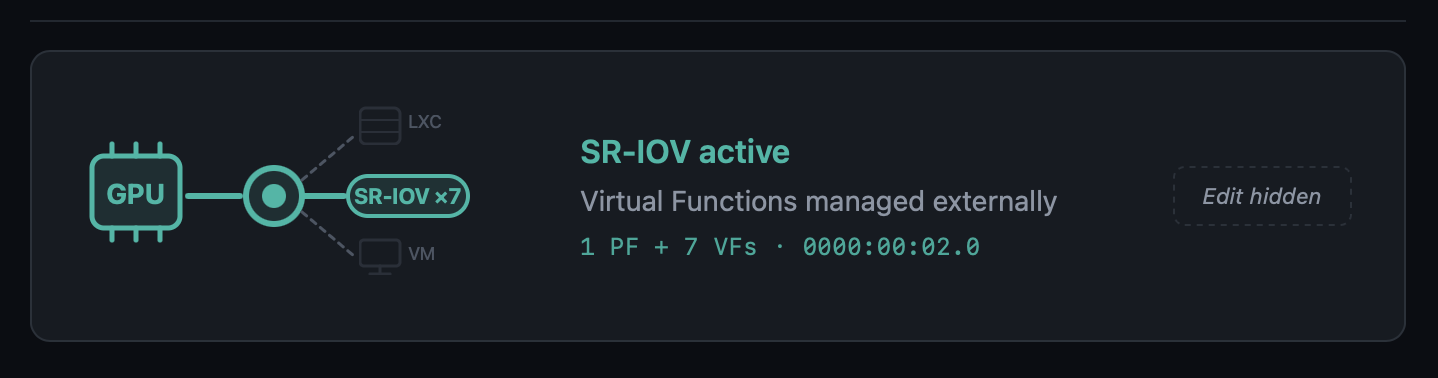
### Modal dashboard for SR-IOV GPUs
Opening the modal for a Physical Function with active VFs now shows:
- Aggregate-metrics banner ("Metrics below reflect the Physical Function, aggregate across N VFs")
- Normal GPU real-time telemetry for the PF
- A **Virtual Functions** table, one row per VF, with the current driver (`i915`, `vfio-pci`, unbound) and the specific VM or LXC that consumes it, including running/stopped state — consumers are discovered by cross-referencing `hostpci` entries and `/dev/dri/renderDN` mount lines against the VF's BDF and DRM render node
Opening the modal for a Virtual Function shows its parent PF (clickable to navigate back to the PF's modal), current driver, and consumer.
### VM Conflict Policy popup no longer fires for SR-IOV VFs
The regex in `detect_affected_vms_for_selected` matched the slot (`00:02`) against VMs that had a VF (`00:02.1`) assigned, producing a confusing "Keep GPU in VM config" dialog. With the SR-IOV gate upstream, the flow never reaches that code path for SR-IOV slots.
---
## 🔊 GPU + Audio Passthrough — Full Lifecycle Hardening
A round of fixes around how GPU passthrough handles its audio companion device. Previously, only the `.1` sibling of a discrete GPU was picked up automatically; Intel iGPU passthrough to a VM — where the audio lives separately on the chipset at `00:1f.3` and not at `00:02.1` — was silently skipped. On detach, the old `sed` that wiped hostpci lines by slot substring could also remove an unrelated GPU whose BDF happened to contain the search slot as a substring (e.g. slot `00:02` matching inside `0000:02:00.0`). Both paths are now robust.
### iGPU audio-companion checklist on attach
`add_gpu_vm.sh::detect_optional_gpu_audio` keeps the auto-include fast path for the classic `.1` sibling (discrete NVIDIA / AMD with HDMI audio on the card). When no `.1` audio exists, the script now:
- Scans sysfs for every PCI audio controller on the host
- Skips anything already covered by the GPU's IOMMU group
- Asks the user via a `_pmx_checklist` (`dialog` in standalone mode, `whiptail` in wizard mode called from `vm_creator`/`synology`/`zimaos`) which audio controllers to pass through alongside the GPU
- Displays each entry with its current host driver (`snd_hda_intel`, `snd_hda_codec_*`, etc.) so the decision is informed
- Defaults to **none** — the user actively opts in
### Orphan audio cascade on detach
When the user picks "Remove GPU from VM config" during a mode switch, the scripts now follow up with a targeted cleanup:
-`switch_gpu_mode.sh`, `switch_gpu_mode_direct.sh` and `add_gpu_vm.sh::cleanup_vm_config` (source-VM cleanup on the "move GPU" flow) all call the shared helper `_vm_list_orphan_audio_hostpci`
- The helper uses a two-pass scan of the VM config: pass 1 records slot bases of display/3D hostpci entries; pass 2 classifies audio entries and **skips any audio whose slot still has a display sibling in the same VM** — protecting the HDMI audio of other dGPUs left in the VM
- Previously the bare substring match would have flagged NVIDIA's `02:00.1` as orphan when detaching an Intel iGPU at `00:02.0`
- The interactive switch flow confirms removals with a `dialog` checklist (default ON). The web variant auto-removes without prompting — the runner has no good way to render a checklist — and logs every BDF it touched
### vfio.conf cascade extension
For each audio removed by the cascade, the switch-mode scripts now check whether its BDF is still referenced by any other VM via `_pci_bdf_in_any_vm`. If nothing else uses it, the `vendor:device` is appended to `SELECTED_IOMMU_IDS` before the `/etc/modprobe.d/vfio.conf` update runs. That closes the loop for the Intel iGPU case: `8086:51c8` (PCH HD Audio) is now pulled from `vfio.conf` alongside `8086:46a3` (iGPU) when both leave VM mode and no other VM references them. If another VM still uses the audio, the ID is deliberately kept — no breaking side effects on other VMs. `add_gpu_vm.sh` does NOT extend the cleanup in the *move* flow, because the GPU is still in use elsewhere and its IDs must remain.
### Precise hostpci removal regex
Every inline `sed` used to detach a GPU from a VM config previously matched the slot as a free substring:
```
/^hostpci[0-9]+:.*${slot}/d
```
For `slot=00:02` that pattern matches the substring inside `0000:02:00.0` (an unrelated NVIDIA dGPU at slot `02:00`) and would wipe both cards. The fix anchors the match to the real BDF shape:
Applied in `switch_gpu_mode.sh`, `switch_gpu_mode_direct.sh` and `add_gpu_vm.sh::cleanup_vm_config`. The awk-based helper in `vm_storage_helpers.sh::_remove_pci_slot_from_vm_config` (used by the NVMe wizards) already used the correct pattern and did not need changes.
Three coordinated fixes that unblock model categories previously rejected by the notification enhancement pipeline.
### OpenAI-compatible endpoints
LiteLLM, MLX, LM Studio, vLLM, LocalAI, Ollama-proxy — the provider's `list_models()` used to require `"gpt"` in every model name, so local setups serving `mlx-community/...`, `Qwen3-...`, `mistralai/...` saw an empty model list. When a Custom Base URL is set, the `"gpt"` substring check is now skipped and `EXCLUDED_PATTERNS` (embeddings, whisper, tts, dall-e) is the only filter. The Flask route layer also stops intersecting the result against `verified_ai_models.json` for custom endpoints — the verified list only describes OpenAI's official model IDs and was erasing every local model the user actually served.
### OpenAI reasoning models
`o1`, `o3`, `o3-mini`, `o4-mini`, `gpt-5`, `gpt-5-mini`, `gpt-5.1`, `gpt-5.2-pro`, `gpt-5.4-nano`, etc. (excluding the `*-chat-latest` variants) use a stricter API contract: `max_completion_tokens` instead of `max_tokens`, no `temperature`. Sending the classic chat parameters produced HTTP 400 Bad Request for every one of them. A detector in `openai_provider.py` now branches the payload accordingly and sets `reasoning_effort: "minimal"` — by default these models spend their output budget on internal reasoning and return an empty reply for the short notification-translation request.
### Gemini 2.5+ / 3.x thinking models
`gemini-2.5-flash`, `2.5-pro`, `gemini-3-pro-preview`, `gemini-3.1-pro-preview`, etc. have internal "thinking" enabled by default. With the small token budget used for notification enrichment (≤250 tokens), the thinking budget consumed the entire allowance and the model returned empty output with `finishReason: MAX_TOKENS`. `gemini_provider.py` now sets `thinkingConfig.thinkingBudget: 0` for non-`lite` variants of 2.5+ and 3.x, so the available tokens go to the user-visible response. Lite variants (no thinking enabled) are untouched.
---
## 📋 Verified AI Models Refresh
`AppImage/config/verified_ai_models.json` refreshed for the providers re-tested against live APIs. The new private maintenance tool (kept out of the AppImage) re-runs a standardised translate+explain test against every model each provider advertises, classifies pass / warn / fail, and prints a ready-to-paste JSON snippet. Re-run before each ProxMenux release to keep the list current.
| Provider | New recommended | Notes |
|----------|-----------------|-------|
| **OpenAI** | `gpt-4.1-nano` | `gpt-4.1-nano`, `gpt-4.1-mini`, `gpt-4o-mini`, `gpt-4.1`, `gpt-4o`, `gpt-5-chat-latest`, plus `gpt-5.4-nano` / `gpt-5.4-mini` from 2026-03. Dated snapshots and legacy models excluded. Reasoning models supported by code but not listed by default — slower / costlier without improving notification quality |
| **Gemini** | `gemini-2.5-flash-lite` | `gemini-2.5-flash-lite`, `gemini-2.5-flash` (works now), `gemini-3-flash-preview`. `latest` aliases intentionally omitted — resolved to different models across runs and produced timeouts in some regions. Pro variants reject `thinkingBudget=0` and are overkill for notification translation |
| Groq / Anthropic / OpenRouter | *unchanged* | Marked with a `_note` — will be re-verified as soon as keys are available |
---
## 🩺 Disk Health Monitor — Observation Persistence in the Journal Watcher
A latent bug in `notification_events.py::_check_disk_io` meant real-time kernel I/O errors caught by the journal watcher were surfaced as notifications but never written to the permanent per-disk observations table. In practice the parallel periodic dmesg scan usually recorded the observation shortly after, but under timing edge cases (stale dmesg window, service restart right after the error, buffer rotation) the observation could go missing.
The journal watcher now records the observation before the 24h notification cooldown gate, using the same family-based signature classification (`io_<disk>_ata_connection_error`, `io_<disk>_block_io_error`, `io_<disk>_ata_failed_command`) as the periodic scan. Both paths now deduplicate into the same row via the UPSERT in `record_disk_observation`, so occurrence counts are accurate regardless of which detector fired first.
---
## 🔧 NVIDIA Installer Polish
### `lsmod` race condition silenced
During reinstall, the module-unload verification in `unload_nvidia_modules` produced spurious `lsmod: ERROR: could not open '/sys/module/nvidia_uvm/holders'` errors because `lsmod` reads `/proc/modules` and then opens each module's `holders/` directory, which disappears transiently while the module is being removed. The check now reads `/proc/modules` directly and inserts short sleeps to let the kernel finalise the unload before re-verifying. Applied in the same spirit to the four other `lsmod` call sites in the script.
### Dialog → whiptail in the LXC update flow
The "Insufficient Disk Space" message in `update_lxc_nvidia` and the "Update NVIDIA in LXC Containers" confirmation now use `whiptail`-style dialogs consistent with the rest of the in-flow messaging, avoiding the visual break that `dialog --msgbox` caused when rendered mid-sequence in the container-update phase.
---
## 🧵 LXC Lifecycle Helper — Timeout-Safe Stop
A plain `pct stop` can hang indefinitely when the container has a stale lock from a previous aborted operation, when processes inside (Plex, Jellyfin, databases) ignore TERM and fall into uninterruptible-sleep while the GPU they were using is yanked out, or when `pct shutdown --timeout` is not enforced by pct itself. Field reports of 5+ min waits during GPU mode switches made this a real UX hazard.
New shared helper `_pmx_stop_lxc <ctid> [log_file]` in `pci_passthrough_helpers.sh`:
1. Returns 0 immediately if the container is not running
2. Best-effort `pct unlock` (silent on failure) — most containers aren't actually locked; we only care about the cases where they are
3.`pct shutdown --forceStop 1 --timeout 30` wrapped in an external `timeout 45` so we never wait longer than that for the graceful phase, even if pct stalls on backend I/O
4. Verifies actual status via `pct status` — pct can return non-zero while the container is in fact stopped
5. If still running, `pct stop` wrapped in `timeout 60`. Verify again
6. Returns 1 only if the container is truly stuck after ~107 s total — the wizard moves on instead of hanging
Wired into the three GPU-mode paths that stop LXCs during a switch: `switch_gpu_mode.sh`, `switch_gpu_mode_direct.sh`, and `add_gpu_vm.sh::cleanup_lxc_configs`.
---
## ⚙️ `add_gpu_vm.sh` Reboot Prompt Stability
The final "Reboot Required" prompt of the GPU-to-VM assignment wizard was triggering spurious reboots in certain menu-chain invocations (`menu` → `main_menu` → `hw_grafics_menu` → `add_gpu_vm`). With the `_pmx_yesno` helper it sometimes returned exit 0 without the user having actually confirmed, calling `reboot` immediately. With a bare `read` in its place the process would get SIGTTIN-suspended when the menu chain detached the script from the terminal's foreground process group, leaving `[N]+ Stopped menu` on the parent shell with no chance to answer.
The prompt now uses `whiptail --yesno` invoked directly (the pattern verified to work reliably in that menu chain) and inserts a `Press Enter to continue ... read -r` pause between the "Yes" answer and the actual `reboot` call — so an accidental Enter on the confirm button cannot trigger an immediate reboot without a visible confirmation step first.
---
### 🙏 Thanks
Thank you to the users who reported the SR-IOV, LiteLLM/MLX and GPU + audio cases — these improvements exist because of detailed, reproducible reports. Feel free to keep reporting issues or suggesting improvements 🙌.
---
## 2026-04-17
### New version ProxMenux v1.2.0 — *AI-Enhanced Monitoring*
This release is the culmination of the v1.1.9.1 → v1.1.9.6 beta cycle and introduces the biggest evolution of **ProxMenux Monitor** to date: AI-enhanced notifications, a redesigned multi-channel notification system, a fully reworked hardware and storage experience, and broad performance improvements across the monitoring stack. It also consolidates all recent work on the Storage, Hardware and GPU/TPU scripts.
- **Per-Event Configuration** — enable/disable specific event types per channel
- **Channel Overrides** — customize notification behaviour per channel
- **Secure Webhook Endpoint** — external systems can send authenticated notifications
- **Encrypted Storage** — API keys and sensitive data stored encrypted
- **Queue-Based Processing** — background worker with automatic retry for failed notifications
- **SQLite-Based Config Storage** — replaces file-based config for reliability
### Telegram Topics Support
Send notifications to a specific topic inside groups with Topics enabled.
- New **Topic ID** field on the Telegram channel
- Automatic detection of topic-enabled groups
- Fully backwards compatible
### ProxMenux Update Notifications
The Monitor now detects when a new ProxMenux version is released.
- **Dual-channel** — monitors both stable (`version.txt`) and beta (`beta_version.txt`)
- **GitHub integration** — compares local vs remote versions
- **Dashboard Update Indicator** — the ProxMenux logo changes to an update variant when a new version is detected (non-intrusive, no popups)
- **Persistent state** — status stored in `config.json`, reset by update scripts
- Single toggle in Settings controls both channels (enabled by default)
---
## 🖥️ Hardware Panel — Expanded Detection
The Hardware page has been significantly expanded, with better detection and richer per-device detail.
- **SCSI / SAS / RAID Controllers** — model, driver and PCI slot shown in the storage controllers section
- **PCIe Link Speed Detection** — NVMe drives show current link speed (PCIe generation and lane width), making it easy to spot drives underperforming due to limited slot bandwidth
- **Enhanced Disk Detail Modal** — NVMe, SATA, SAS, and USB drives now expose their specific fields (PCIe link info, SAS version/speed, interface type) instead of a generic view
- **Smarter Disk Type Recognition** — uniform labelling for NVMe SSDs, SATA SSDs, HDDs and removable disks
- **Hardware Info Caching** (`lspci`, `lspci -vmm`) — 5 min cache avoids repeated scans for data that doesn't change
The Storage Overview has been reworked around real-time state and user-controlled tracking.
### Disk Health Status Alignment
- Badges now reflect the **current** SMART state reported by Proxmox, not a historical worst value
- **Observations preserved** — historical findings remain accessible via the "X obs." badge
- **Automatic recovery** — when SMART reports healthy again, the disk immediately shows **Healthy**
- Removed the old `worst_health` tracking that required manual clearing
### Disk Registry Improvements
- **Smart serial lookup** — when a serial is unknown the system checks for an existing entry with a serial before inserting a new one
- **No more duplicates** — prevents separate entries for the same disk appearing with/without a serial
- **USB disk support** — handles USB drives that may appear under different device names between reboots
### Storage and Network Interface Exclusions
- **Storage Exclusions** section — exclude drives from health monitoring and notifications
- **Network Interface Exclusions** — new section for excluding interfaces (bridges `vmbr`, bonds, physical NICs, VLANs) from health and notifications; ideal for intentionally disabled interfaces that would otherwise generate false alerts
- **Separate toggles** per item for Health monitoring and Notifications
### Disk Detection Robustness
- **Power-On-Hours validation** — detects and corrects absurdly large values (billions of hours) on drives with non-standard SMART encoding
- **Intelligent bit masking** — extracts the correct value from drives that pack extra info into high bytes
- **Graceful fallback** — shows "N/A" instead of impossible numbers when data cannot be parsed
---
## 🧠 Health Monitor & Error Lifecycle
### Stale Error Cleanup
Errors for resources that no longer exist are now resolved automatically.
- **Deleted VMs / CTs** — related errors auto-resolve when the resource is removed
- **Removed Disks** — errors for disconnected USB or hot-swap drives are cleaned up
- **Cluster Changes** — cluster errors clear when a node leaves the cluster
- **Log Patterns** — log-based errors auto-resolve after 48 hours without recurrence
- **Security Updates** — update notifications auto-resolve after 7 days
### Database Migration System
- **Automatic column detection** — missing columns are added on startup
- **Schema compatibility** — works with both old and new column naming conventions
- **Backwards compatible** — databases from older ProxMenux versions are supported
- **Graceful migration** — no data loss during schema updates
---
## 🧩 VM / CT Detail Modal
The VM/CT detail modal has been completely redesigned for usability.
### New version v1.1.9 — *Helper Scripts Catalog Rebuilt*
### Changed
- **Helper Scripts Menu — Full Catalog Rebuild**
The Helper Scripts catalog has been completely rebuilt to adapt to the new data architecture of the [Community Scripts](https://community-scripts.github.io/ProxmoxVE/) project.
The previous implementation relied on a `metadata.json` file that no longer exists in the upstream repository. The catalog now connects directly to the **PocketBase API** (`db.community-scripts.org`), which is the new official data source for the project.
A new GitHub Actions workflow generates a local `helpers_cache.json` index that replaces the old metadata dependency. This new cache is richer, more structured, and includes:
- Script type, slug, description, notes, and default credentials
- OS variants per script (e.g. Debian, Alpine) — each shown as a separate selectable option in the menu
- Direct GitHub URL and **Mirror URL** (`git.community-scripts.org`) for every script
- Category names embedded directly in the cache — no external requests needed to build the menu
Scripts that support multiple OS variants (e.g. Docker with Alpine and Debian) now correctly show **one entry per OS**, each with its own GitHub and Mirror download option — restoring the behavior that existed before the upstream migration.
---
### 🎖 Special Acknowledgment
This update would not have been possible without the openness and collaboration of the **Community Scripts** maintainers.
When the upstream metadata structure changed and broke the ProxMenux catalog, the maintainers responded quickly, explained the new architecture in detail, and provided all the information needed to rebuild the integration cleanly.
Special thanks to:
- **MickLeskCanbiZ ([@MickLesk](https://github.com/MickLesk))** — for documenting the new script path structure by type and slug, and for the clear and direct technical guidance.
- **Michel Roegl-Brunner ([@michelroegl-brunner](https://github.com/michelroegl-brunner))** — for explaining the new PocketBase collections structure (`script_scripts`, `script_categories`).
The Helper Scripts project is an extraordinary resource for the Proxmox community. The scripts belong entirely to their authors and maintainers — ProxMenux simply offers a guided way to discover and launch them. All credit goes to the community behind [community-scripts/ProxmoxVE](https://github.com/community-scripts/ProxmoxVE).
- **Offline Execution Mode (no GitHub dependency)**
All ProxMenux core scripts now run **entirely locally**, without requiring live requests to GitHub (`raw.githubusercontent.com`).
This change provides:
- Greater stability during execution
- No interruptions due to network timeouts or regional GitHub blocks
- Support for **offline or isolated environments**
⚠️ This update resolves recent issues where users in certain regions were unable to run scripts due to CDN or TLS filtering errors while downloading `.sh` files from GitHub raw URLs.
**🎖 Special Acknowledgment: @cod378**
This offline conversion has been made possible thanks to the extraordinary work of **@cod378**,
who redesigned the entire internal logic of the installer and updater, refactored the file management system,
and implemented the new fully local execution workflow.
Without his collaboration, dedication, and technical contribution, this transformation would not have been possible.
- **ProxMenux Monitor v1.0.1**
This update brings a major leap in the **ProxMenux Monitor** interface.
New features and improvements:
-`Proxy Support`: Access ProxMenux through reverse proxies with full functionality
-`Authentication System`: Secure your dashboard with password protection
-`Two-Factor Authentication (2FA)`: Optional TOTP support for enhanced security
-`PCIe Link Speed Detection`: View NVMe connection speeds and detect performance bottlenecks
-`Enhanced Storage Display`: Auto-formats disk sizes (GB → TB when appropriate)
-`SATA/SAS Interface Info`: Detect and show storage type (SATA, SAS, NVMe, etc.)
-`Health Monitoring System`: Built-in system health check with dismissible alerts
- Improved rendering across browsers and better performance
- **Helper Scripts Menu (Mirror Support)**
The `Helper Scripts` menu now:
- Detects **mirror URLs** and shows alternative download options when available
- Lists available OS versions when a helper script is version-dependent (e.g. template installers)
---
### Fixed
- Minor fixes and refinements throughout the codebase to ensure full offline compatibility and a smoother user experience.
Your new monitoring tool for Proxmox. Discover all the features that will help you manage and supervise your infrastructure efficiently.
ProxMenux Monitor is designed to support future updates where **actions can be triggered without using the terminal**, and managed through a **user-friendly interface** accessible across multiple formats and devices.
A new function to disable the Proxmox subscription message with improved safety:
- Creates a full backup before modifying any files
- Shows a clear warning that breaking changes may occur with future GUI updates
- If the GUI fails to load, the user can revert changes via SSH from the post-install menu using the **"Uninstall Options → Restore Banner"** tool
Special thanks to **@eryonki** for providing the improved method.
---
### Improved
- **CORAL TPU Installer Updated for PVE 9**
The CORAL TPU driver installer now supports both **Proxmox VE 8 and VE 9**, ensuring compatibility with the latest kernels and udev rules.
- **Log2RAM Installation & Integration**
- Log2RAM installation is now idempotent and can be safely run multiple times.
- Automatically adjusts `journald` configuration to align with the size and behavior of Log2RAM.
- Ensures journaling is correctly tuned to avoid overflows or RAM exhaustion on low-memory systems.
- **Network Optimization Function (LXC + NFS)**
Improved to prevent “martian source” warnings in setups where **LXC containers share storage with VMs** over NFS within the same server.
- **APT Upgrade Progress**
When running full system upgrades via ProxMenux, a **real-time progress bar** is now displayed, giving the user clear visibility into the update process.
---
### Fixed
- Other small improvements and fixes to optimize runtime performance and eliminate minor bugs.
- **Configure LXC Mount Points (Host ↔ Container)** - **Core feature** that enables mounting host directories into LXC containers with automatic permission handling. Includes the ability to **view existing mount points** for each container in a clear, organized way and **remove mount points** with proper verification that the process completed successfully. Especially optimized for **unprivileged containers** where UID/GID mapping is critical.
- **Configure NFS Client in LXC** - Set up NFS client inside privileged containers
- **Configure Samba Client in LXC** - Set up Samba client inside privileged containers
- **Configure NFS Server in LXC** - Install NFS server inside privileged containers
- **Configure Samba Server in LXC** - Install Samba server inside privileged containers
The entire system is built around the **LXC Mount Points** functionality, which automatically detects filesystem types, handles permission mapping between host and container users, and provides seamless integration for both privileged and unprivileged containers.
In the automatic post-install script, the Log2RAM installation function now prompts the user when automatic disk ssd/m2 detection fails.
This ensures Log2RAM can still be installed on systems where automatic disk detection doesn't work properly.
---
### Fixed
- **Proxmox Update Repository Verification**
Fixed an issue in the Proxmox update function where empty repository source files would cause errors during conflict verification. The function now properly handles empty `/etc/apt/sources.list.d/` files without throwing false warnings.
Thanks to **@JF_Car** for reporting this issue.
---
### Acknowledgments
Special thanks to **@JF_Car**, **@ghosthvj**, and **@jonatanc** for their testing, valuable feedback, and suggestions that helped refine the shared resources functionality and improve the overall user experience.
This version prepares **ProxMenux** for the upcoming **Proxmox VE 9**:
- The function to add the official Proxmox repositories now supports the new `.sources` format used in Proxmox 9, while maintaining backward compatibility with Proxmox 8.
- Banner removal is now optionally supported for Proxmox 9.
- **xshok-proxmox Detection**
Added a check to detect if the `xshok-proxmox` post-install script has already been executed.
If detected, a warning is shown to avoid conflicting adjustments:
```
It appears that you have already executed the xshok-proxmox post-install script on this system.
If you continue, some adjustments may be duplicated or conflict with those already made by xshok.
Do you want to continue anyway?
```
---
### Improved
- **Banner Removal (Proxmox 8.4.9+)**
Updated the logic for removing the subscription banner in **Proxmox 8.4.9**, due to changes in `proxmoxlib.js`.
- **LXC Disk Passthrough (Persistent UUID)**
The function to add a physical disk to an LXC container now uses **UUID-based persistent paths**.
This ensures that disks remain correctly mounted, even if the `/dev/sdX` order changes due to new hardware.
```bash
PERSISTENT_DISK=$(get_persistent_path "$DISK")
if [[ "$PERSISTENT_DISK" != "$DISK" ]] ...
```
- **System Utilities Installer**
Now checks whether APT sources are available before installing selected tools.
If a new Proxmox installation has no active repos, it will **automatically add the default sources** to avoid installation failure.
- **IOMMU Activation on ZFS Systems**
The function that enables IOMMU for passthrough now verifies existing kernel parameters to avoid duplication if the user has already configured them manually.
---
### Fixed
- Minor code cleanup and improved runtime performance across several modules.
Improved the `remove_subscription_banner` function to ensure compatibility with Proxmox 8.4.5, where the banner removal method was failing after clean installations.
- **Improved Log2RAM Detection**
In both the automatic and customizable post-install scripts, the logic for Log2RAM installation has been improved.
Now it correctly detects if Log2RAM is already configured and avoids triggering errors or reconfiguration.
- **Optimized Figurine Installation**
The `install_figurine` function now avoids duplicating `.bashrc` entries if the customization for the root prompt already exists.
Added a new function `setup_persistent_network` to create stable network interface names using `.link` files based on MAC addresses.
This avoids unpredictable renaming (e.g., `enp2s0` becoming `enp3s0`) when hardware changes, PCI topology shifts, or passthrough configurations are applied.
**Why use `.link` files?**
Because predictable interface names in `systemd` can change with hardware reordering or replacement. Using static `.link` files bound to MAC addresses ensures consistency, especially on systems with multiple NICs or passthrough setups.
Special thanks to [@Andres_Eduardo_Rojas_Moya] for contributing the persistent
network naming function and for the original idea.
1.**Lite version (no translations):** Only installs two official Debian packages (`dialog`, `jq`) to enable menus and JSON parsing. No files are written beyond the configuration directory.
2.**Full version (with translations):** Uses a virtual environment and allows selecting the interface language during installation.
When updating, if the user switches from full to lite, the old version will be **automatically removed** for a clean transition.
The CPU selection menu in VM creation has been greatly expanded to support advanced QEMU and x86-64 CPU profiles.
This allows better compatibility with modern guest systems and fine-tuning performance for specific workloads, including nested virtualization and hardware-assisted features.
- Special thanks to **@Blaspt** for validating the persistent Coral USB passthrough and suggesting the use of `/dev/coral` symbolic link.
### Added
- **Persistent Coral USB Passthrough Support**
Added udev rule support for Coral USB devices to persistently map them as `/dev/coral`, enabling consistent passthrough across reboots. This path is automatically detected and mapped in the container configuration.
- **RSS Feed Integration**
Added support for generating an RSS feed for the changelog, allowing users to stay informed of updates through news clients.
- **Release Service Automation**
Implemented a new release management service to automate publishing and tagging of versions, starting with version **v1.1.2**.
Fixed an issue where some recent Proxmox installations lacked the `/usr/local/bin` directory, causing errors when installing the execution menu. The script now creates the directory if it does not exist before downloading the main menu.\
- **Balanced Memory Optimization for Low-Memory Systems**
Improved the default memory settings to better support systems with limited RAM. The previous configuration could prevent low-spec servers from booting. Now, a more balanced set of kernel parameters is used, and memory compaction is enabled if supported by the system.
```bash
cat <<EOF|sudotee/etc/sysctl.d/99-memory.conf
# Balanced Memory Optimization
vm.swappiness = 10
vm.dirty_ratio = 15
vm.dirty_background_ratio = 5
vm.overcommit_memory = 1
vm.max_map_count = 65530
EOF
# Enable memory compaction if supported by the system
if [ -f /proc/sys/vm/compaction_proactiveness ]; then
echo "vm.compaction_proactiveness = 20" | sudo tee -a /etc/sysctl.d/99-memory.conf
fi
# Apply settings
sudo sysctl -p /etc/sysctl.d/99-memory.conf
```
These values help maintain responsiveness and system stability even under constrained memory conditions.
Added a new script called `Help and Info`, which provides an interactive command reference menu for Proxmox VE through a dialog-based interface.
This tool offers users a quick way to browse and copy useful commands for managing and maintaining their Proxmox server, all in one centralized location.
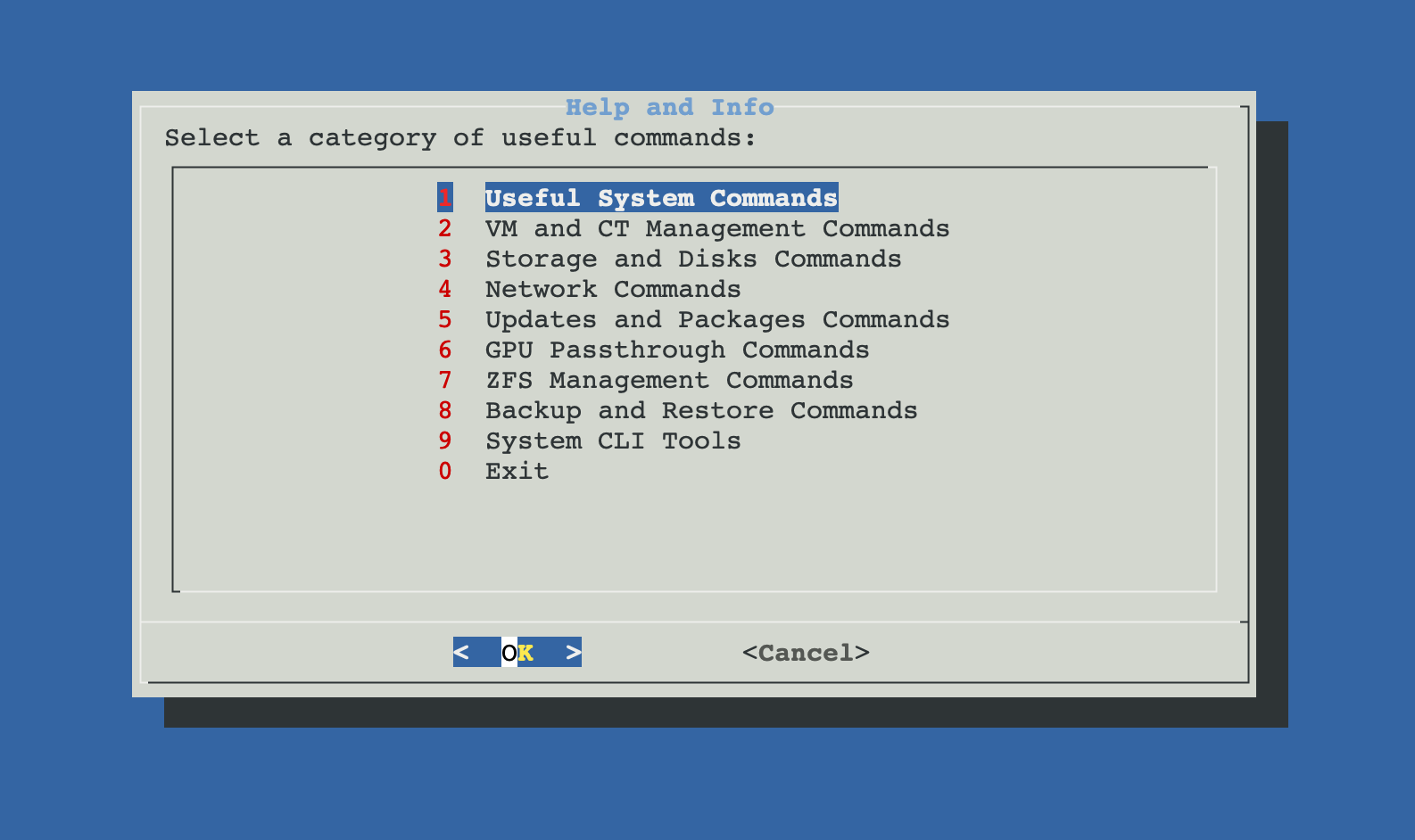
*Figure 1: Help and Info interactive command reference menu.*
- **Uninstaller for Post-Install Utilities**
A new script has been added to the **Post-Installation** menu, allowing users to uninstall utilities or packages that were previously installed through the post-install script.
### Improved
- **Utility Selection Menu in Post-Installation Script**
The `Install Common System Utilities` section now includes a menu where users can choose which utilities to install, instead of installing all by default. This gives more control over what gets added to the system.
- **Old PV Header Detection and Auto-Fix**
After updating the system, the post-update script now includes a security check for physical disks with outdated LVM PV (Physical Volume) headers.
This issue can occur when virtual machines have passthrough access to disks and unintentionally modify volume metadata. The script now detects and automatically updates these headers.
If any error occurs during the process, a warning is shown to the user.
- **Faster Translations in Menus**
Several post-installation menus with auto-translations have been optimized to reduce loading times and improve user experience.
Introduced a new script that enables assigning a dedicated physical disk to a container (CT) in Proxmox VE.
This utility lists available physical disks (excluding system and mounted disks), allows the user to select a container and one disk, and then formats or reuses the disk before mounting it inside the CT at a specified path.
It supports detection of existing filesystems and ensures permissions are properly configured. Ideal for use cases such as Samba, Nextcloud, or video surveillance containers.
- Visual Identification of Disks for Passthrough to VMs
Enhanced the disk detection logic in the Disk Passthrough to a VM script by including visual indicators and metadata.
Disks now display tags like ⚠ In use, ⚠ RAID, ⚠ LVM, or ⚠ ZFS, making it easier to recognize their current status at a glance. This helps prevent selection mistakes and improves clarity for the user.
- Improved the logic for detecting physical disks in the **Disk Passthrough to a VM** script. Previously, the script would display disks that were already mounted in the system on some setups. This update ensures that only unmounted disks are shown in Proxmox, preventing confusion and potential conflicts.
- This improvement ensures that disks already mounted or assigned to other VMs are excluded from the list of available disks, providing a more accurate and reliable selection process.
- Improved the logic of the post-install script to prevent overwriting or adding duplicate settings if similar settings are already configured by the user.
- Added a warning note to the documentation explaining that using different post-installation scripts is not recommended to avoid conflicts and duplicated settings.
### Added
- **Create Synology DSM VM**:
A new script that creates a VM to install Synology DSM. The script automates the process of downloading three different loaders with the option to use a custom loader provided by the user from the local storage options.
Additionally, it allows the use of both virtual and physical disks, which are automatically assigned by the script.
